

We are embedding sustainability into our strategy
Our sustainability strategy underpins our three strategic pillars. Having our sustainability strategy grounded in these business outcomes and vice versa helps to ensure that, as a group, we are actively prioritising the management of sustainability-related risks and opportunities.
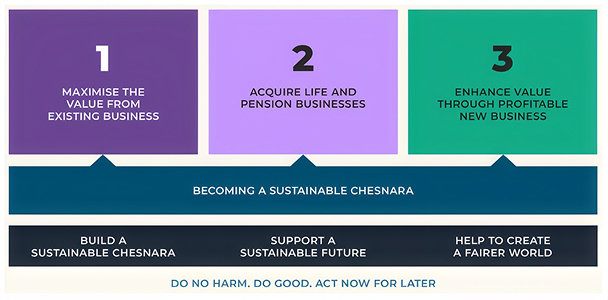
Building a sustainable Chesnara
Our sustainability strategy focuses on building a sustainable Chesnara, supporting a sustainable future and helping to create a fairer world.
We are also committed to our sustainability values:
- Do no harm.
- Do good.
- Act now for later
Our plan to reach net zero
We published our first Climate Transition Plan (CTP), Our Plan to Reach Our Net Zero Ambition, in September 2025.
Impact: Over 99.9% of our emissions come from the companies we and our customers invest in.1
Ambitions:
- Net zero by 2050.
- 50% reduction from our 2023 baseline in scope 1 and 2 emissions intensity2 by 2030 for listed equity and corporate fixed income investments we can influence or control.3
- £125m of shareholder funds invested in climate solutions by 2030.
Key Actions
- Engage asset managers and investee companies to support decarbonisation and transition planning.
- Increase exposure to green bonds, net-zero aligned funds, and nature-based partnerships.
- Consider divestment where engagement has not been successful, or exclusion principles are breached.
Core objectives
- Aligning our portfolio with net zero
- Driving change through engagement
Impact: While smaller in scale, our ambition to reduce operational emissions reflects our commitment to lead by example.
Ambitions:
- Net zero by 2050.
- 60% reduction from our 2023 baseline in scope 1 and 2 emissions by 20304
Key Actions
- Procure renewable energy to power our business.
- Improve building efficiency.
- Set travel emissions target by 2027.
Core objectives
- Reducing our operational footprint
- Driving change through engagement
Impact: Our supply chain is the largest source of operational emissions, driven by purchased goods and services.
Ambitions:
- Net zero by 2050.
- 90% of material⁵ with science-based targets by 2030.
Key Actions
- Embed sustainability criteria into the supplier selection process and onboarding.
- Seek or procure quality data from suppliers.
- Develop environmental, social and governance (ESG) supply chain standards and engage suppliers on their own decarbonisation plans.
Core objectives
- Reducing our operational footprint
- Driving change through engagement
- Policy and regulation: Our ability to set and deliver credible targets depends on clear, stable and long-term policy frameworks. Clarity and stability can increase our options and accelerate progress.
- Asset managers: Most of our investments are externally managed. Influencing our external asset managers on their climate ambition, data quality and engagement practices can positively impact our ability to meet our ambitions.
- Data and methodology: Reliable and comparable data is essential for setting targets and tracking progress and consistent data across the market can help improve precision and comparability.
- Customers: Aligning our climate ambition with delivering long-term value and financial security and taking into account customer needs and risk preferences can progress our ability to decarbonise.
- Peers & industry norms: Collective action strengthens our influence. If peers are aligned, it can enhance our engagement impact and create clear, consistent signals for companies.
- Acquisitions: As a consolidator, our portfolio and emissions profile will evolve. Consistent and transparent reporting and rebaselining procedures will enable us to demonstrate how acquisitions are being factored into our plans.
- Macro-economic factors: General economic conditions and movements, together with the effects of a changing climate, will impact the wider societal and policy shifts that underpin our transition.

Sustainability Reporting
Please take a look at our sustainability reporting and let us know any feedback you have. We look forward to continuing to update you on progress. We ask that you consider the environment and don't print.
Footnotes
1 Emissions generated from investments are those categorised as scope 3 category 15 of the GHG Protocol.
2 The absolute greenhouse gas emissions associated with an asset class or portfolio divided by the loan and investment volume, expressed in tonnes CO2e/USD M invested.
3 ‘Investments we can influence or control’ as defined in our CTP.
4 Calculated using market-based methodology for the electricity that we procure.
5 Suppliers that generate 1% or greater of our total scope 3 category 1 emissions are classified as material.